 Saasy
Saasy

NZ's Online Harm Inquiry: Empowering Schools to Keep Students Safe
In March 2026, New Zealand's parliament released one of the most important reports ever written about student safety online. The findings are...
Online student safety goes beyond online security. When schools genuinely protect students in digital spaces, they build the trust, attention, and relationships that drive lasting student wellbeing.
Ask someone how schools keep students safe online and you will often hear the same answers: strong passwords, spotting phishing emails, protecting personal information, avoiding suspicious links and using multi-factor authentication (MFA).
They are all important. But they're examples of online security.
The two terms are often used interchangeably, yet they address fundamentally different challenges. Understanding that distinction is important because protecting school systems is not the same as protecting the students using them.
Online security focuses on protecting school systems, networks and data from external threats. It is technical, procedural and designed to prevent unauthorised access, malware, phishing attacks and data breaches.
Teaching students not to reuse passwords, recognise phishing emails and use multi-factor authentication are all examples of good online security practices.
A school firewall is also part of online security. It blocks malicious websites, filters internet traffic and helps prevent external threats from reaching the school network.
Online student safety focuses on protecting students and staff while they are using technology. It is behavioural, relational and concerned with how young people experience digital environments.
Cyberbullying, grooming, coercion, exposure to harmful content, self-harm discussions, suicidal ideation, and the impact of social media on wellbeing are all online student safety issues. These risks frequently occur inside trusted platforms that schools use such as Microsoft Teams, Google Workspace, learning management systems, email and AI tools.
A firewall cannot identify a student being cyberbullied in a group chat. It cannot recognise escalating self-harm language in a shared document. It cannot detect grooming behaviour occurring in approved communication platforms. Those are student safety challenges, not network security challenges.
Online security and online student safety are complementary, not competing disciplines. One protects the technology. The other protects the people using it.
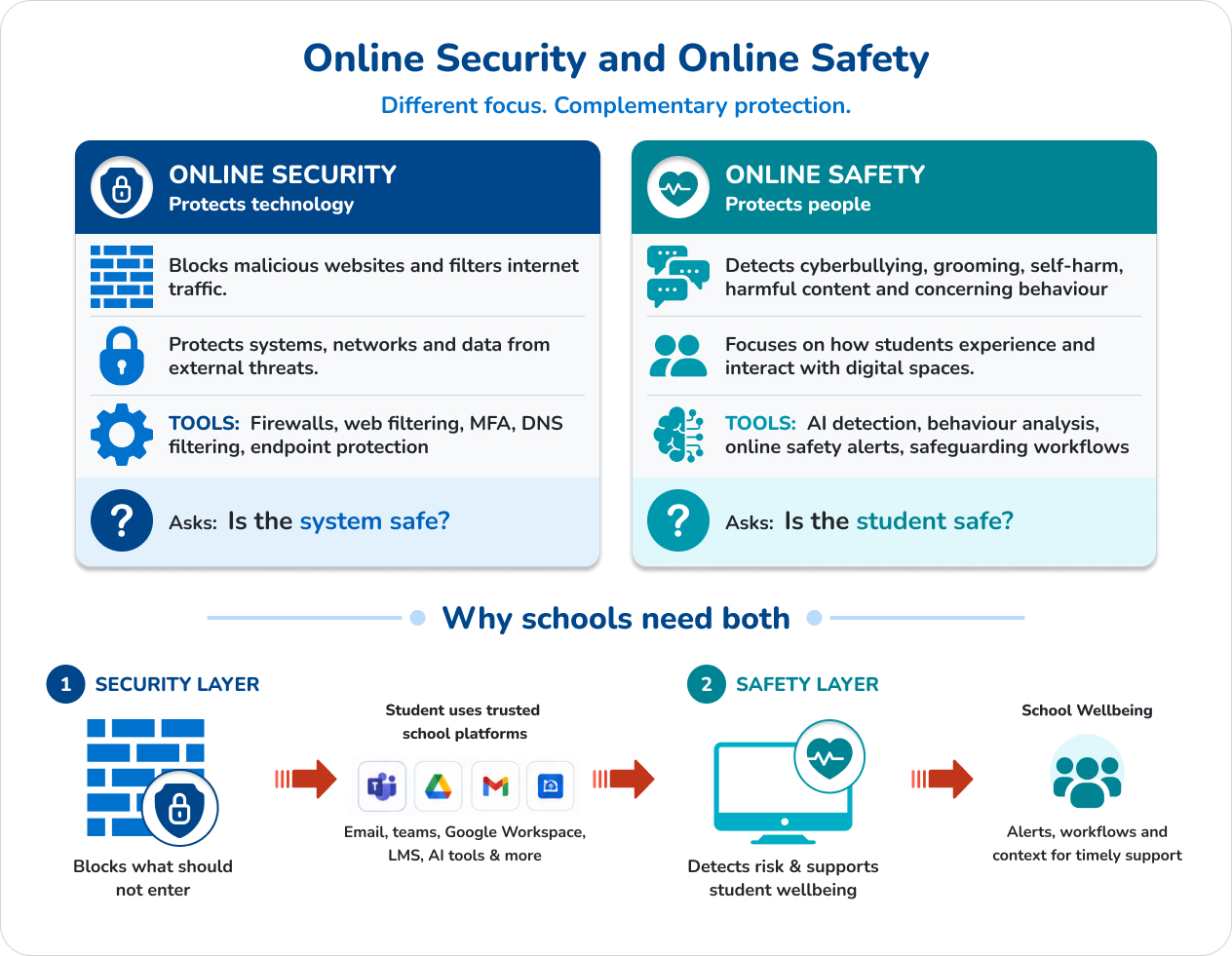
Schools don't need to choose between online security and online student safety. They need both. Security provides the foundation. Online safety ensures technology remains a place where young people can learn, connect and thrive.
Effective online student safety is built on one non-negotiable habit: noticing what is happening and responding when something looks wrong. Schools that do this well develop systems for recognising changes in student behaviour, patterns in how young people are communicating online, and signals that something might be going on beneath the surface.
Those signals are rarely limited to online risk. A student being targeted by a cyberbully is probably not thriving emotionally. A student who has stumbled into harmful content is often already in a vulnerable place. A student whose online behaviour shifts dramatically is frequently telling us something important about what is happening in their life more broadly.
When schools build the capacity to notice these signals, they are not just catching online safety incidents. They are identifying students who need support, often before those students would have sought help themselves. The infrastructure of online student safety becomes, in practice, the infrastructure of care.
One of the most powerful tools in any online student safety programme is the conversation itself. Whether it happens in a classroom lesson, a pastoral check-in, or a quiet word after school, talking with students about what they encounter online requires schools to create genuine space for young people to share things that are difficult to say.
That kind of space does not close when the topic changes. A student who has been heard and taken seriously when they reported something upsetting online learns that this is a school where people listen. A student who has been guided through a difficult situation without shame or punishment learns that they can return when the next difficult situation arrives. And the next difficult situation will come, whether it is a mental health struggle, a problem at home, or a friendship falling apart.
The relational habits that good online student safety work builds are exactly the relational habits that support student wellbeing. You cannot teach one without the other.
The deeper curriculum of online student safety, the part that goes beyond lists of rules and into genuine education, is about how we treat each other and ourselves. It covers respect, empathy, consent, the impact our words have on other people, and the way we manage our own emotions under pressure. It asks students to think about why they make the choices they make, and what kind of person they want to be when no one is watching.
This is, plainly, a student wellbeing curriculum. The same conversations that teach students to be responsible online are also conversations about identity, belonging, relationships, and resilience. Schools that run these programmes well find that students come away better equipped to navigate difficult social dynamics, manage anxiety about social comparison, and develop a clearer sense of who they are beyond their screens.
Research from the Digital Wellness Lab at Boston Children's Hospital confirms what many practitioners already observe: integrated digital citizenship and social and emotional learning programmes produce measurable improvements in empathy, emotional awareness, and students' capacity to regulate their own behaviour online and off.
The evidence base connecting online student safety to student wellbeing and mental health outcomes is growing, and it points consistently in one direction.
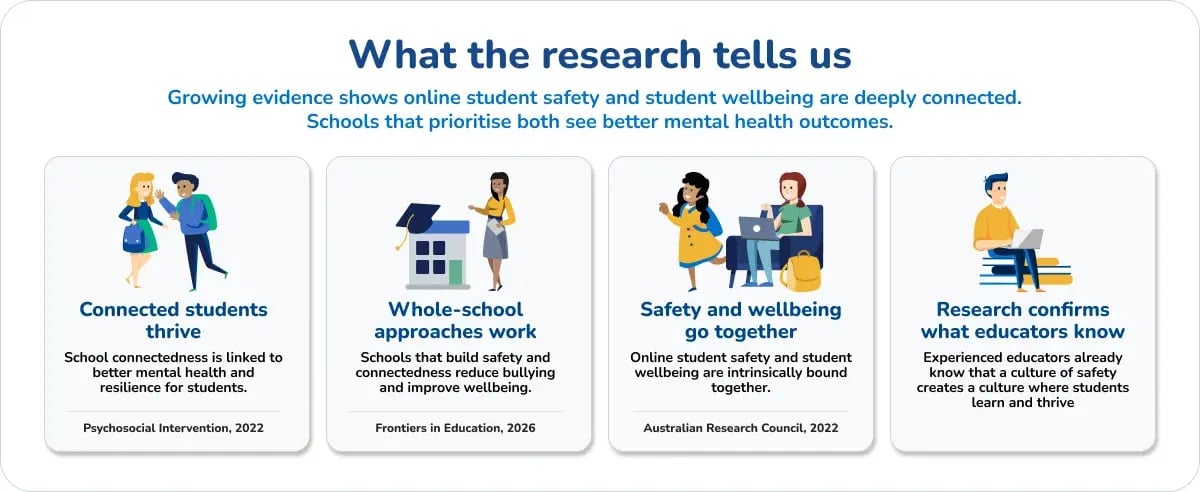
A multilevel study published in Psychosocial Intervention (2022), drawing on data from 1,774 students across 31 secondary schools, found that school-level connectedness buffers the mental health impact of cyberbullying, including depression, lowered self-esteem, and suicidal behaviour. Schools that build cultures of online student safety, in other words, are also building cultures that protect young people's mental health.
A 2026 systematic review in Frontiers in Education found that whole-school interventions focused on perceived safety and connectedness produced lasting reductions in student anxiety, depression, and bullying. The same review concluded that schools must now integrate digital wellbeing research directly into their broader mental health frameworks rather than treating online security and student wellbeing as separate concerns.
An Australian Research Council study published in 2022 examined the practices in primary and secondary schools that contribute to students' felt sense of safety and wellbeing. Its findings highlighted the deeply bundled nature of this work: you cannot meaningfully pursue online student safety without also advancing student wellbeing.
This is what experienced school leaders already know. The research is simply confirming it.
If your school is building or reviewing its approach to online student safety, the practical implication is straightforward: do not design it as a standalone programme sitting apart from online security checklists and annual cybersafety lessons. Design it as part of your pastoral and student wellbeing strategy. Train the same staff. Use the same language. Build the same feedback loops.
Ask whether your online student safety programme gives students someone to talk to, or only something to avoid. Ask whether it is teaching young people how to think, or only what not to do. Ask whether students who go through it feel more capable and more connected, or simply more cautioned.
When you ask those questions honestly, the path forward is usually clear. Online student safety and student wellbeing are not two separate commitments competing for the same budget and the same time. They are, at their core, the same commitment: to young people who are supported, seen, and capable of navigating a complex world.
Start with safety. You will find wellbeing waiting there.
The eSafety Commissioner's Schools Toolkit is a practical starting point for any school ready to move beyond online security and into genuine online student safety. It covers whole-school approaches, staff training, student education, and parent engagement, all of which map directly to the student wellbeing outcomes this article describes. You can access it at esafety.gov.au/schools.
For schools that want the visibility to act on what they notice, Saasyan Assure gives pastoral and wellbeing staff real time insight into what students are encountering online, so that the right conversation can happen at the right time.
Collin, P. et al. (2022). Best Practice Framework for Online Safety Education: Results from a rapid review of the international literature, expert review, and stakeholder consultation. ScienceDirect. https://www.sciencedirect.com/science/article/pii/S2212868922000150
Graham, A. et al. (2022). Promoting students' safety and wellbeing: ethical practice in schools. The Australian Educational Researcher. https://www.ncbi.nlm.nih.gov/pmc/articles/PMC9427083/
Morin, A.J.S. et al. (2022). Bullying, cyberbullying and mental health: the role of student connectedness as a school protective factor. Psychosocial Intervention, 31(1), 33–41. https://www.ncbi.nlm.nih.gov/pmc/articles/PMC10268552/
Digital Wellness Lab, Boston Children's Hospital (2025). Research Brief: Digital Media and Technology for Social-Emotional Learning. https://digitalwellnesslab.org/research-briefs/research-brief-digital-media-and-technology-for-social-emotional-learning/
Neosantara Hybrid Learning (2025). Integrating social-emotional learning (SEL) into a hybrid middle school curriculum to foster digital wellbeing and resilience. Journal Neosantara Hybrid Learning. https://research.adra.ac.id/index.php/jnhl/article/view/3358
Frontiers in Education (2026). Impact of school ethos on student mental health and wellbeing: a systematic review of whole-school approaches. https://www.frontiersin.org/journals/education/articles/10.3389/feduc.2026.1827335/full
In March 2026, New Zealand's parliament released one of the most important reports ever written about student safety online. The findings are...
Why Digital Safety Matters Digital safety in schools is evolving rapidly. It’s no longer just about blocking harmful content. It’s about supporting...
With the Saasyan Assure API Connector for Google Workspace, schools are able to apply Assure's advanced analytics and AI features to monitor all...